Strings Quartet V – Minimal
In B Minor
I had sat down in my front room and had a play through of my first four string quartets with friends. I remain really grateful for that experience, because not only did it teach me a huge amount about how my works actually sounded, their technical playability, whether they were indeed fun to play, and whether they worked or not, it’s also just an unparalleled experienced to be surrounded by great musicians who put time and effort into interpreting your music.
And then I wrote the fifth. One of the things I understood from playing the fourth, even in the second violin seat, is that much of what I write is challenging. As I was writing the opening bars of the fifth, I knew that I wasn’t going to be sufficiently competent to pull it off as a performer. The tunes of this piece are all reserved for the viola, whilst the two violins are emulating interfering waves on the surface of a large body of water. This is bit like playing Steve Reich: the interference pattern moves only slowly in beats across the bar, and the violins have to be 100% accurate for the impressionism to actually work.
So, I knew I wasn’t going to play it, and would have get in some heavyweights to have a go. I found them in SoundPost Studio, conservatoire trained ex-pats who’d emigrated to the US, and had now found their way to Brazil. Led by Mikhail, this was the start of a relationship that has lasted.
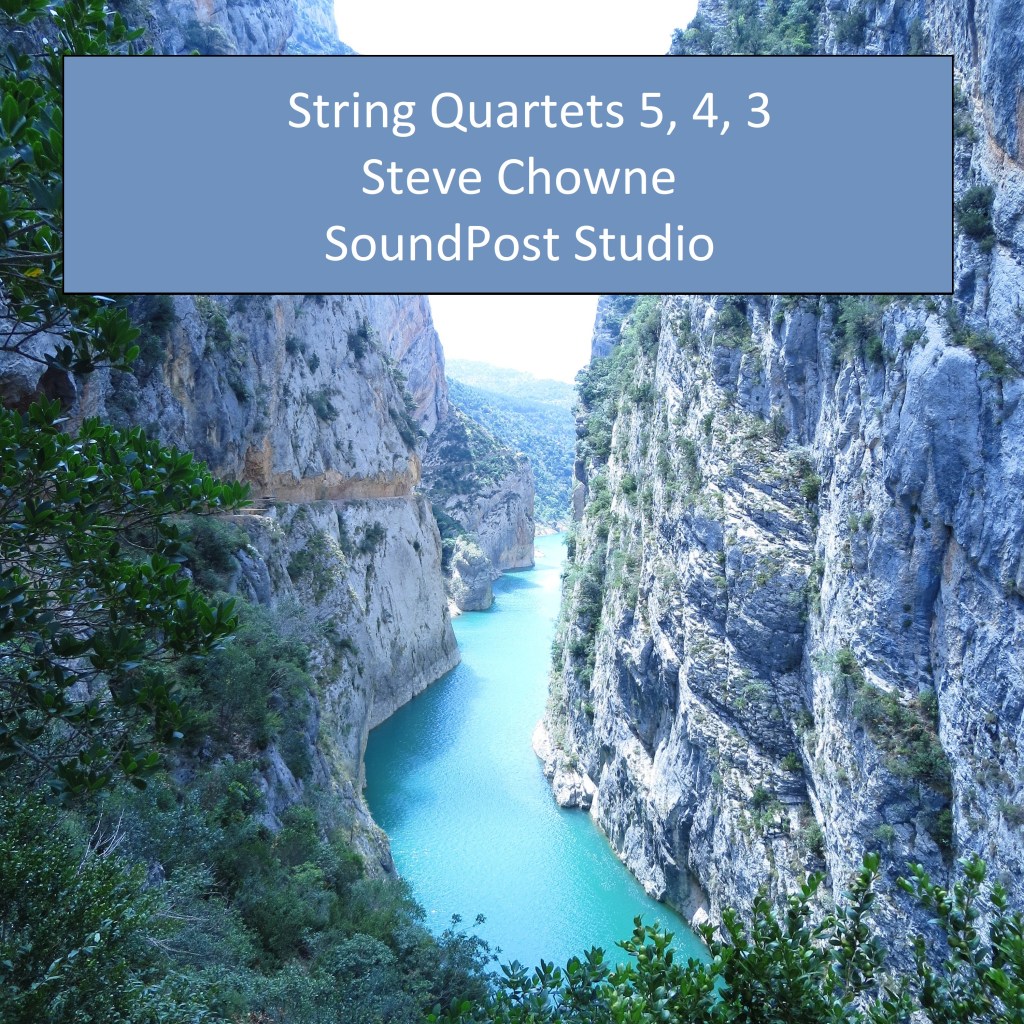
In fact the whole of the fifth quartet is about water. The opening movement has fairly traditional structure. Subtitled interfering ripples, it keeps coming back to that the idea of pulses or waves from each instrument being the ripples of waves in the water’s surface. As the waves cross each other, the patterns they make are complex, producing another moving pattern. Physicists and Engineers study and exploit these patterns, but then so do musicians and artists in both harmony and form.
The second movement tones down the complexity. Mikhail’s favourite movement of the piece – this is a solo first violin singing over a soundtrack of pizzicato bubbles. The inconsistent rubarto across the accompaniment is quite deliberate and brings home a room full of bubble pipes, possibly in a shady cool market in the middle east somewhere.
The segue of the third movement, Total Internal Reflection, is a mathematical figure. Just a few bars long, it takes a chord and turns it upside down, like the light reflected from the underside of the surface of a pool of water.
And to finish us off, Eddies is a light dance of swirls in fast moving water. More complexity, but ephemeral: nothing lasts in this one – it’s constantly moving forward to the piece’s conclusion.
This was the first quartet of mine to be properly recorded, born of me writing in way I could no longer personally play. An interesting development that opened the door to writing for other instruments I’d never studied.
String Quartet IV – Play
In D Major
The inspiration behind this fourth quartet is one of those big old reel-to-reel tape recorders, such as a Uher. We used to use them all the time when recording our band, Blue Powder, back in the university days. That’s a different story, which the interested can read about in detail on bluepowder.uk.
Rather like the smaller compact cassette decks that normal people had in their shiny hi-fis and Sony Walkmans of the time, these twin-reeled machines had a few key buttons on them to control the tape drive motor. Rather obviously, you could play forwards, spin fast forwards to try and find something more interesting, rewind (also faster than normal play speed), pause, or stop, disengaging the tape heads altogether. . Whilst such controls seem so ridiculously antiquated and pedestrian in today’s digital world, it was the essential technology of its time, and its legacy persists in the iconography we still use in players today.
Three of these buttons are the key behind this quartet then:
In the first movement, it’s about moving forward quicker than normal speed. Fast Forward brings together the four players in bright excitement, to the edge to holding things together.
The second movement is about taking a moment to take stock – to pause and consider what’s just happened. I’ve already pegged this as something I want played at my funeral.
And to close, a Rewind Rondo. This is the silliest concept – each time the rondo returns to the main theme (ABACADA etc), the piece re-winds the last dozen of so bars of harmony in reverse order at high speed, as if the wheels of the tape machine were being spun backwards before being played again. Fun, but it takes much concentration to pull off.
String Quartet III – Snow
In E Minor
This entire piece was inspired by a blackbird ferreting around in the snow in my back garden. You can hear the bird’s alarm cry in the first violin in the opening few bars, as it is disturbed and flies off into the safety of the hedge.
This is easier to play than the second quartet, but it is probably harder to play well since the themes are long and drawn out over the four movements. In concept, it all revolves around snow:
In the first movement, we hear the blackbird scurrying around searching for the few pickings available in the winter garden. The bird somehow knows that the bad weather is coming, and is trying make whatever preparations it can before the pressure unavoidably drops and a heavy snow falls, blanketing everything. It goes quiet.
In the second movement, the kids rush out into the fresh snow first thing the next morning to immediately instigate a snowball fight. You can hear it flying around until everyone is too tired to move and they trudge home wet, cold and tired.
In the third movement, we understand that the cold is here to last. It freezes overnight, and what was pretty is now crisp and isolating. The fourth movement expands upon the consequences of isolation – being trapped indoors without contact, maybe without provisions, until the distant thaw. It’s lonely and cold and a complete juxtaposition to the excitement of the snowball fight.
Players
Performed by Mikhail Bugaev and SoundPost Studio.
Mixing by Mikhail Bugaev.
Sheet Music
My String Quartets 1-9 are available to purchase as a single volume containing all separate parts; please enquire through Bandlab. A copy is also available to hire from NewSPAL – New Surrey Performing Arts Library,
 Steve Chowne Music