Violin Concerto – The Effervescent (2021)
In D Major
Violin – Ohla Iliashenko (follow link for bio)
The middle slow movement of this violin concerto was the first element of this whole collection to see the light of day, initially pushed out as a stand-alone piece called Balance. I even released a recording of me playing the solo on SoundCloud. It wasn’t however until a few years later that I actually finished the job, and wrote the rest of the piece.
In my mind, this was always going to be a three-movement concerto, and there were elements of it swirling around when Balance was done, but the simplicity of Balance was too attractive to ignore and leave in the drawer, albeit unfinished. In essence, I’d written something simple enough that I could play comfortably enough myself to be heard in public.
So the rest followed in due course. The middle movement is light, gentle and peaceful. It’s a respite in the middle of something more energetic, but actually this whole piece is airy. There isn’t a grain of angst in it, and this probably sets it aside from much of my catalogue.
The feel of the opening Allegro then is another neo-classical number. It’s bouncy and happy and immediately commands the attention with it’s energy and melodic acrobatics. In fact it was really important to me when writing it to make it catchy. I measured the success of that intent in how my friend David Burton, (leader of the excellent Redhill Sinfonia in which I play) reacted when I asked him to review and edit my draft work during the pandemic in 2020. His opening comment was that I had come up with a real earworm. As you can imagine, coming from someone who knows his stuff, this sort of praise landed and I clearly haven’t forgotten.
David did a fantastic job of editing the piece. His input was invaluably positive through his suggestions to enhance and improve playability. Let’s face it, if it’s going to be catchy, the person playing has got to want to play it, and they’ve got to sound like they want to play it. My friend Louisa Orton who appears in my other violin concerto below, had a go at it at home, and let me have a listen to her playing in her back room. That was a fabulous evening and the smile on my face lasted for days as she too gave me confidence to press on with it.
With much practice and persistance, I got to the point where I could play the first two movements reasonably well. Not well enough to pull off a proper recording though, and the way in which I’d penned the very energetic third movement and its candenza was frankly beyond my soloistic credentials. I could play it through to prove it possible, but this was never going to be front of anyone else.
So I found Olha, a young and extremely talented violinist in Ukraine. She was looking for work, and her CV was brilliant. I needn’t have worried. I gave her the gig, instructions to make the piece her own, and she delivered something absolutely brimming with life. It was huge fun to then piece together the string orchestra around her.
This is a wonderfully positive end result. And David was right.
Piano Concerto – The Inspired (2023)
In B Minor
Piano – Stan O’Beirne (follow link for bio)
This was undoubtedly the biggest scale of concerto I’d attempted to date, and despite having learnt the instrument through all the grades as a nipper, I was under no illusion from the start: I would be getting someone else to play the end result. One of the things I’d learnt from the experience of putting together the Arboretum and Preludes, Promenades and Nocturnes albums before was that not only did I really enjoy hearing what superior performing musicians brought to my written notes, they invariably improved them too. By choosing the right player, I would get new layers I had never actually written, built up on top my work. They gave it depth and shine and usually made me cry. I remember from way back doing my O’levels reading something about when Holst first heard the full orchestra playing his Mars, and how he was brought to tears by their realisation of what was in his head. I can’t find the text now, but I know how he probably felt.
I first heard Stan’s draft recording over my very draft orchestra backdrop whilst taking a dawn walk out from a short stay in hospital. It was an unwelcoming winter morning and I was getting some very fresh air whilst his fingers pushed magic and warmth from my airpods into my head. I must have looked most weird stopped on the side of the busy road clearly a bit overwhlemed with the emotion of what I was hearing.
Like Polina before him, Stan was doing something to really bring this music alive, something I don’t have the skill to do with my own fingers. Maybe if I practised a bit more? But then I’d have less time to write stuff like this and there’s nothing quite like hearing someone else do it better.
Like Polina, Stan is a bit of a prodigy, and it doesn’t take much to find an article on him saying how good he is. What’s even more amazing is that he recorded this piece in between his (engineering) exams at uni, so I had to exercise plenty of patience waiting to extract the second two movements off him. It was absolutely worth the wait.
Once again, it was the slow movement that was penned first of the three in this piece. Not by design, but by inspiration. There are so many inlufences and motiviations behind the music, it would be churlish not to acknowledge them since they all play a part. First up would by Shostakovich, whose second piano concerto has always been one of those that has been relatively accessible for pianists who are good but not sufficiently of concert standard to have a go at bashing out. And along with the third Prokofiev, these are probably my two favourite piano concerti. The opening of my middle movement definitely has a nod to Shostakovich’s middle movement, But then it develops more a Ravel feel as it meanders around. I remember loving Martha Argerich playing the Ravel at the proms, and absolutely melting as she shared this joyous work, expertly ranging from the heart rending to the rip roaring. So yes, Ravel’s concerto is another key inspiration – both in seeing Martha bouncing up on down on her piano stool clearly having fun like so many concert piants don’t, and in Ravel stating of his own work that he was aiming to entertain rather then be profound.
But then, listen casually to the themes of the opening movement, there is more than a nod to late romanticism of Rachmaninov in there too, and why not? Where does Prokofiev fit? Probably in a happy Shostakovich mash up with all those manic scales and runs.
We are all the product of our experiences. As a kid, I would listen to an awful lot of Queen and the Beatles – past masters at combining styles that don’t have anything to do with each other. So I’m not the only one that does it, and maybe that’s why this sounds like it does. Whatever the influences – this is defintely my work, and I love what Stan did with it.
Cello Concerto – The Dark (2022)
In C Minor
“Ooh, that’s dark,” was first the reaction that this work generated on being put in front of a prospective soloist. They loved it so much they nearly bit my hand off for the opportunity to record it. But it wasn’t to be as the guy I’d tracked down near Cairo to interpret this, my longest concerto to date, unfortuately developed carpal tunnel during rehearsals and had to pull out. We were both devastated, and the recording project went into stasis for many months.
It took me a an age to find another soloist I was happy with, but I did. After the protracted delays of the first attempt to get this recorded, Alice got the project back on track in a matter of days. It was her style that had convinced me to give her the piece, and her assessment of the work on paper reassured me that it should all work well. We remained fully open to modifications and improvements, but in less than a week she had not only mastered the piece, she had completed the initial recordings from her place in Italy. A tiny handful of edits were all that were needed. She’d brought tenderness and a real power to those deep strings, fluency and energyto the fast passages and it absolutely throbbed with emotion.
This piece was probably the biggest gamble so far. I have never learnt the cello, and so writing a full concerto for this instrument was the first time I have attempted something from such a position of ignorance. I’ve studied violin and piano, and whilst not a soloist, I know how the mechanics work. I also knew from various feedback on my numerous string quartets that some of my scribblings for the larger instruments had been flawed with the sort of assumptions that violinists make about how violas and cellos are played. The fingering doesn’t always translate. The bowing doesn’t always translate. In fact, if I had a pound for every time the cello section at orchestra rehearsals complain to the leader about bowing or technique having to follow the first violins, I’d probably have a tenner by now.
There are many cello concerti that I’ve come across in my life, but without a doubt, the most influential will have been the Elgar. I was required to study it for O Level music – something that comprised my music teacher, Chris Greenhalgh, giving me a cassette tape the week before the exam, and saying:
“Listen to that a few times.”
(It was a Comprehensive education, but I did get an A, so he probably knew what he was doing.)
I still love the Elgar, whose influences are no doubt obvious to even the casual listener. Over the subsequent years I came to know other super cello works like the Walton, the Prokofiev, the Shostakovich and even the Saint Seans which we recently put on in my local orchestra, Redhill Sinfonia with an outstanding twelve year old, Ruwan Dias. All brilliant, and these pieces all no doubt found their way into my subconcious.
I asked another of my friends, Julian Gillett, the principle cellist at Redhill Sinfonia to do me the honour of giving the first draft a play through back in 2022. This gave me an extremely useful insight into the playability of what I’d written, and he encouraged me to persist. He too thought it was wonderfully dark, perfectly performable, and a good piece. And he offered insights into tweaks I could make for improvements for the solo part that I would never otherwise have gained. Friends who tell you like it is are so important. He also said it was hard; that I needed someone rather good to play it well. I happen to think Julian is a brilliant cellist, so those wise words were probably really saying something.
The piece is in four movements, with consistent themes running throughout. I scored it for a substantial orchestra of strings, wind, horns and percussion, with lots of ebbing and flowing in the tempi. This was a significant challenge to record, especially in the way in which all the parts of were recording independently. This no doubt justified why it took almost two years to realise the recording. It’s complex but lush, and I’m again delighted with the outcome, struggling to sometimes believe that I came up with it.
Violin Concerto – The Alluring (2021)
In G Minor
If asked to name my favourite violin concerto of all time, it would probably be one of the two Prokofievs. Which one would depend which day it was. My collection includes the Vengerov / Rostropovich recordings of both, and they are both absolute stunners in the powerful emotions they wrench from the soloist pitted against orchesta. Truly beautiful writing and performances.
The more popular Bruch and Mendlesohn and Sibelius and Beethoven also rank too of course. Why wouldn’t they? I’ve played them (slowly) in the privacy of my own home without anyone other than my long suffering wife listening, since they are more playable than the Russian stuff. All great, but not what I wanted to write.
My violin concerto in G Minor was in fact the first full concerto I completed, despite the Balance movement of the violin concerto in D being recorded first. Unlike the D Major, the G Minor concerto was written in order, with the overall framework already in mind. I’d been listening to the Walton cello, and had decided that slow – quick – slow was the way to go to be different to the bulk of the extensive violin concerto catalogue.
The initial phrase of the first movement came quickly, and turned into a page, and then another twenty pages, almost rhapsodic or fantasic in form. This was maybe ten years earlier, and whilst I had been suitably proud of the thing I’d produced, it was overly complex and lacking in structure. It was also extremely challenging to play, and with some feedback from my composition tutor, Noriko Shorney at the time, I learned that it was extremely challenging to listen to because of its lack of structure of excessive number of ideas crammed. Lilke many early pieces, it was shelved, and I went off and studied some more Bach.
I picked it up again many years later when the concerto writing bug was biting again, armed with more constraint and a little more confidence from having some of my other orchestral work performed in public. I tore up much of the extensive material originally written and instead instilled a framework around the key bits of theme and development that made the most sense. Several months later, I had a first movement I could actually just about play, which if nothing was a good start. I wanted lush and emotional. I was focussed onthe deeper end of the violin, often underused in the violin concerto.
The second movement went to the other end of other instrument. It’s more virtuosic and significantly more challenging in its scherzo. It plays with the time signature to deliberately up the ante, nipping from 3 to 4 and back. Fast and light, then fast and furious. The Russian influence is probably most significant.
The final movement is probably the best, and Louisa who is playing, agreed with this. It’s almost a recitative, but scored in a tricky way that means everyone in the strings really has to count (in 12) very carefully to come in at the right time in those massive multi-timbral chords swells, whilst the soloist lyrically trills like a nightingale.
I was so lucky with this piece. I have known Louisa for years from Redhill Sinfonia, where she is the hugely respected section leader for the violas. But I happen to know she is also a brilliant violinist. She’s been a regular member of the quartet that has “tried out” some of my quartet drafts in my sitting room before I’ve committed them to the recording process, and has been hugely helpful and encouraging. She’s also very modest saying that her motivation is the opportunity to play something that no one else has ever had the opportunity to play before.
Redhill Sinfonia did me the huge honour of dedicating an evening to this piece in 2023, when the orchestra had a go at it, Louisa taking the solo part at the front. I sat out and listened with my wife, score in hand, soaking it all up whilst John Beswick conducted its first outing. There’s nothing quite like hearing 50 or so brilliant musicians playing your notes.
The solo part here is a recording that Louisa made on her iphone in her back room back in 2021. With a bit of sound engineering magic, I have taken the liberty of subsequently filling in the accompanying string orchestra around her, and editing it all together to pretend it all happened at the same time.
Players
Violin Concerto in D Major performed by Olha Iliashenko, Recorded in Ukraine in 2024.
String Orchestra performed and recorded by Steve Chowne.
Piano Conerto in B Minor performed by Stan O’Beirne. Recorded in Ireland across 2023 and 2024.
Percussion, Horns and String Orchestra performed and recorded by Steve Chowne.
Wind Orchestra performed and recorded by Symph Studio under Miguel Vargas in Venezula.
Cello Concerto in C Minor performed by Alice Mirabella. Recorded in Italy in 2024.
Percussion, Horns and String Orchestra performed and recorded by Steve Chowne.
Wind Orchestra performed and recorded by Symph Studio under Miguel Vargas in Venezula.
Violin Concerto in Gm performed by Louisa Orton. Recorded in the UK in 2021.
String Orchestra performed and recorded by Steve Chowne.
All the superb mixing and mastering again by Luca Zara in Italy.
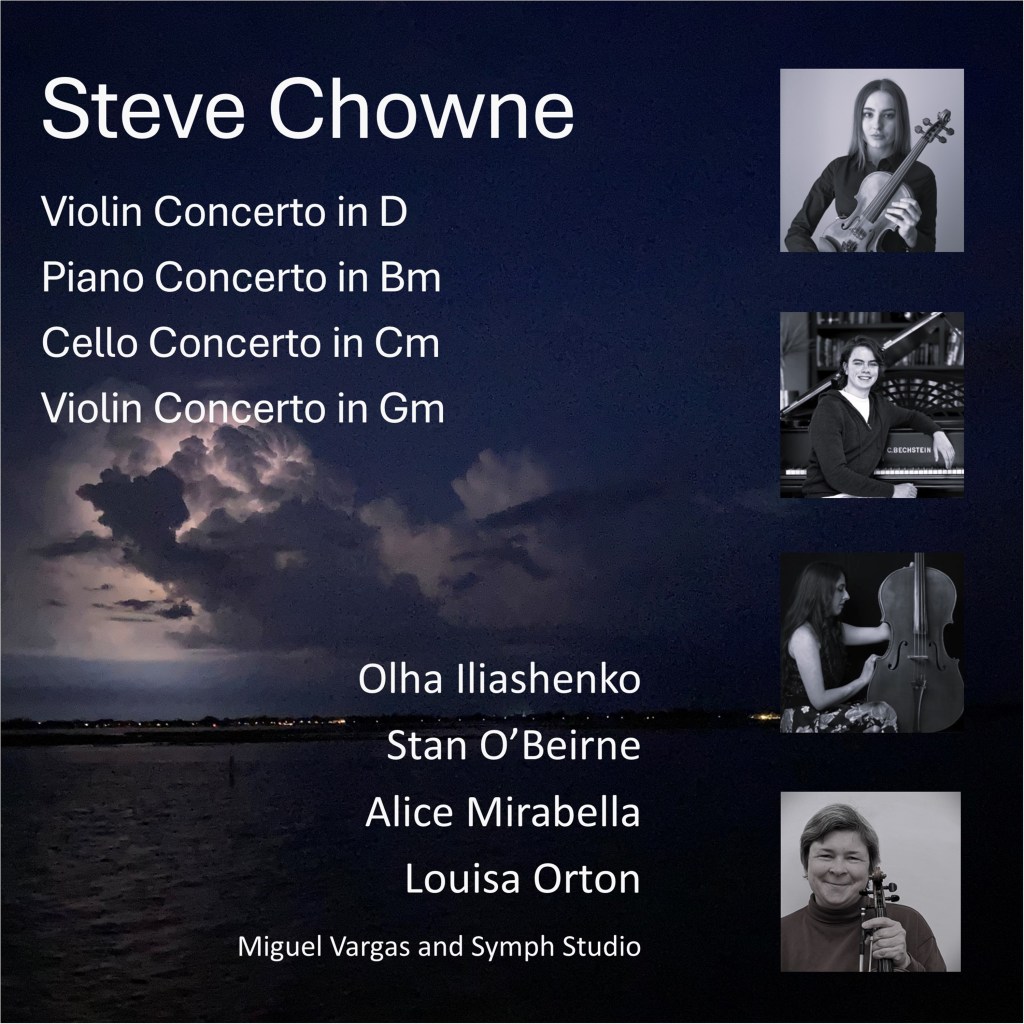
Quattro Concerti is current available to stream on SoundCloud.
 Steve Chowne Music