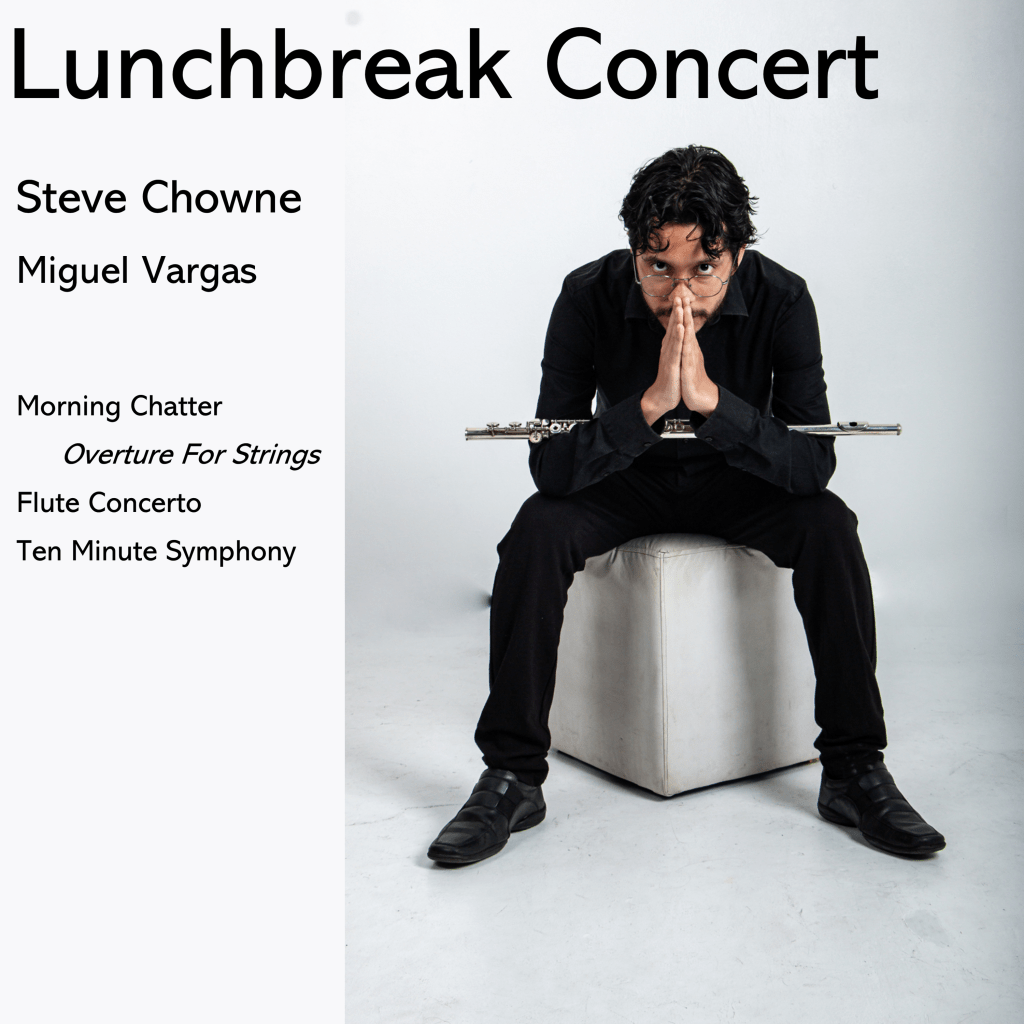
Lunchtime Concert is now streaming on SoundCloud, BandCamp and all the the major streaming services.
Morning Chatter – Overture for Strings (2015)
In D Minor
Premiered in March 2017 by Redhill Sinfonia under John Beswick in an eclectic programming mix of Honegger, Hindemith and Dvorjak, this overture was enthusiastically received by both the players and audience for its effervesence and fun. Written a couple of years earlier in 2015, it is scored simply for string orchestra. The overture attempts to capture the idea of the early morning birds getting ready for their busy day alongside their human neighbours scurrying off to the office or wherever.
I must admit it’s not entirely clear who is the busiest – the commuters or their avian counterparts fighting over space on the branch or branch line. But then the birds get the opportunity to just take off and soar for a few moments, hanging in the air to get away from all the bluster and fuss. Before getting back to the chattering. What are they talking about?
Flute Concerto (2024)
In D Minor
After an unhelpful period of illness, I found my pen again in 2024 and was able to turn my attention to writing a few concerti. I had been so unexpectedly blown away with the results of recording my violin, piano and cello concerti earlier, that I really wanted to have another go at writing in this form for some new instruments. As it turned out, I somehow penned three this year: one for flute, one for tuba, and one for trumpet. More on those brass pieces anon, this is the turn of the wind.
I had stuied the flute as a youngster and had a clutch of certificates to prove it in the attic somewhere. ,So theoretically, I had a reasonable grasp of how the instrument worked, and what it was capable of. I’d also played a fair amount of the repertoire, albeit a few decades ago. I’d found it interesting that flute concerti don’t seem to be programmed very often, and when they are, it’s usually either one of the two Mozart, or something so agressively modern that makes your ears bleed. Of course there are plenty of really good pieces out there, but along with other windy showcases, they don’t seem to get much air play. After thinking about it for a bit, I decided that it was likely to be a combination of solo wind not being sufficiently gutsy to stand in front of the beefy orchestra dynamic that puts bums of concert hall seats, and the alleged limitated tonal variety of wind instruments as soloists. Well that’s what some people were saying, by way of example about RVW’s charming oboe concerto.
Well I’d already decided to write a concerto for flute, so the answer lay in setting appropriate boundaries to make it work. Accordingly, my concerto accompanient is scored lightly for strings and single wind only, which I think addresses the first point. As for the second, I went out of my way to think about all the different pieces I had studied as a teenager which showed off the variety of flutterings that this two foot silver pipe can produce. And I steered well clear of Mozart. Principle acknowledgements belong to Poulenc and Hindemith for motivation, I loved playing that Hindemith sonata – so sultry.
Just as with the recordings of my violin and piano pieces, I had decided up front that I was not going to record myself as the soloist. I could play it, but it was going to sound oh so much better with the interpretation of someone who was not a hack of all trades like me but who had concertrated on it properly. After all. I had picked up the flute as my third instrument even back then.
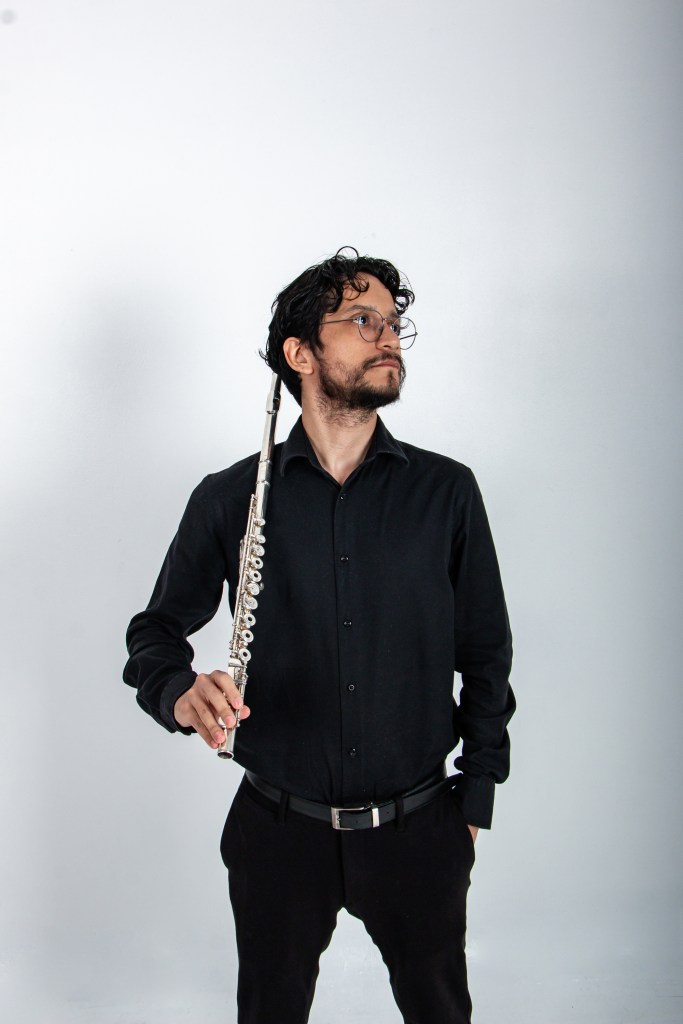
I knew just who. I’ve been working with Miguel for several years throughout much of my earlier catalogue. He first appears as soloist on my album A Nice Bit of Wood, and he has also been supporting many of my subsequent orchestral recordings, both as flautist, and in providing wind parts through his Symph Studio in Venezula, where he teaches alongside the Simon Boliva orchestra.
I was right of course: his interpretation has been fantastic, elevating my notes to something quite else.
Ten Minute Symphony (2017)
In A Minor
The conceit behind this, my first symphony, was to cram a four movement symphony into a scant ten minutes. Hence the title.
It is probably reasonable to question whether it is a real symphony given that it contains pretty much nothing in the way of theme development. But then if it had, it would have overrun the ten minute target and missed the point of the piece. And that point was to write something that gave the idea of a symphony in a bite-sized accessible chunk. The result might well be the unexpected illigitimate child of Prokoviev’s Classical Symphony and Britten’s Young Person’s Guide To The Orchestra. Its feel is neoclassical; it’s light and fluffy, and being so succinct, it’s not doing any harm as a potential vehicle to introduce a new audience to the idea of symphonic form, without having to start with something like Mahler. Classical tiktok if you like.
I’m all for relatively short pieces. There is indeed a place for the more substantial longer work, but you have to be in the mood to give it due reverence and attention. Having contributed to programming committees for a few years, I’ve never quite bought into the idea that audiences will be universally disappointed if they feel a concert is shorter than 90 or 120 minutes. In my experience, the majority of today’s audiences have probably had enough by the interval, expecially when the enthusic curator has scheduled another hour and a half of unknown scratching and scraping. As in everything in art, getting to the point matters. The most important skill I learnt at school was precis. I certainly got a numb and fidgety bum in the finale of the Mission Impossible film franchise, but that’s a different story.
Maybe that’s unfair? Maybe I am setting myself out to be justly accused of not having worked out how to write something that holds the attention for longer? That may well be true; or maybe I just have committed it to record yet. Well, I’m currently working out how to record my second and fifth symphonies….
Eight years after I wrote Ten Minute Symphony, it took a bit longer than ten minutes to put the recording together. I again coerced a number of colleagues from my orchestra, Redhill Sinfonia, to contribute their musical talents , along with the other pieces on this album. And it was great fun doing so. The last movement is a particular romp.
And yes, it does indeed sound like the end of Countdown at the end to make the point that the ten minutes is, indeed, up: your lunchbreak over, back to work.
Players
Lunchbreak concert was performed by members of Redhill Sinfonia Steve Chowne, Jo Anderson, Rebecca Coomber, Alex Sturt, Ian Jenner, Tim Samuel, Mark Welling, Celia Lister, Keith Anderson, and Helen Greaves, to whom I am extremely grateful.
Flute solo by Miguel Vargas. Recorded in Venezula in 2025.
Mixing by Luca Zara.
Sheet Music
Score and Parts for all piecces are available to hire from NewSPAL – New Surrey Performing Arts Library,
 Steve Chowne Music