Cafe Anime
Written in 2023, the idea behind this lively piece was to capture the non-stop effort required to work behind a busy bar. I think in my head it was a coffee bar, but it doesn’t really matter what it’s serving if the queue never goes down all day.
The Anime of the title is more about being animated than Japanese subculture, although if the listeners chooses to imagine a cafe adorned with manga prints, that’s ok with me. I had in mind something quite sultry but full of demanding people wanting instant and great service whilst they chilled out.
My youngest had been learning the sax for a years, and having had the exciitment of accompanying him on a few increasingly challenging grade exams, this was exactly the sort of controlled panic I was aiming for in the piano — something hard but rhymically essentially for the feel of the piece. I think I just about pulled it off. From over in Portugal, Jorge’s sax is excellent – he absolutely nailed the feel of excitement and chill I was writing.
End of Shift
The next two are Jorge’s fault. He so liked doing Cafe Anime, that he suggested that I write a duet and something for tenor. Both came out of the pen later that year in 2023 as a result of his encouragement.
As it happened, it was Kevon who played both parts of this one as Jorge got otherwise engaged with family matters. You can hear the American influence in the style of playing come through; I Iove how the two parts bounce off each other. It’s another bar scenario, but even more frenetic, and you can hear the bar-tenders dancing around each other as they show off their skills at pouring drinks.
The pieces weaves the players around each other into the small hours until they run out of energy and are dead on their feet, collapsing with the tempo.
Finishing a Sad Book At The Back Of The Cafe
This is the second piece written in 2023 that Jorge encouraged me to write, and he did in fact get to play it. In fact he played everything in it from the sultry tenor sax to every bit of the band, which he painstakingly built in layers and layers of samples.
Maybe it’s a cliche for an album to have two upbeat numbers and then a slow one, but it’s a cliche for a good reason. This is unashamedly romantic, and between my writing and Jorge’s execution we didn’t hide away from wearing everything on our sleeves.
The title was all about not being afraid to express emotion in a public place. I think the most public place this has happened to me has been on a plane, when I couldn’t put my sad book down. I had to finish it before landing and just wanted to howl, but had to contend with a quiet sob, staring stoically out the window and sniffing a bit. I’m sure I’m not the only one who’s been there.
Five Wooden Toys
This 2021 suite was whittled from an idea to write five pieces, each one on a different woodwind instrument, expressing the essential characteristics or traits of something else also made of wood. When you stop and think that half of the woodwind family themselves are not actually made of wood, it’s a bit tenuous, but then it’s all abstract anyway.
First up was was the Temperamental Marionette – a dancing puppet. Being a trained flautist, this should have been the simplest to put together, but actually it wasn’t. My flute tooting skills have definitely declined since school days as a result of being distracted by other shiny things (i.e. not practising). The knowledge of what should be possible remains. If anything, it was frustrating that I couldn’t just pick it up and try out what I was writing, but then that’s a common problem in my writing.
I found this excellent flautist, Miguel, who is a teaching professor in Venezuela, and a graduate of the Simon Boliva orchestra. He appears again on this (and subsequent) albums. When I listen to him playing my notes, I see that excellent puppetry bit from Spike Jonze’s weird and wonderful film, Being John Malkovich. (That’s a recommendation, watch it).
If you’re asked to list basson solos, there are a few: that bit in Stravinky’s Rite of Spring, the opening of The Sourcer’s Apprentice, and few more that you instantly recognise when played. I’d always thought the theme tune of Mr Benn was a bassoon until I was re-educated to understand that it is actually a bass clarinet. But I think it was this classic sound of Mr Benn’s fantasic adventures in Festive Road that was probably circling around the back of my head when I wrote Unstable Dominoes. This track is the sound of trying to place dominoes in a record-breaking row ready to be knocked down in one grand sweep, but …. keep knocking one over every time you get twenty or so up. The bassoon in this one is a super competant professional who plays with Albanian state orchestra.
The Artist’s Mannequin is one of those really simple articulated dolls you can get from art shops (or Ikea) to practice painting the human form. For some reason, this mannequin was dancing gracefully in my head like in one of those Pixar shorts. I couldn’t think of anything better than an oboe to trace the movement of its limbs describing smooth arcs as it lightly spun down to rest inanimate again. My oboeist was a session musician, Luis, from Argentina. He clearly knew what he was doing.
The idea behind the Friendly Draught was chequers – the simpler game played on a chess board. In chequers (called draughts in UK English), the counters move one square diagonally per play, unless they are taking a piece, in which case they can jump diagonally over an opponent’s piece, and take it off the board. These movements were the motets at the heart of the piece – little arpeggi to set up one’s position, and then bigger jumps once things got going. Stasys, another conservatoire graduate made this absolutely sing.
The last piece in the set is a ride in a wooden Train Set. Think Wallace and Grommit in The Wrong Trousers and you’re there. If you listen closely, you can hear the “whooo” of the whistle. Playing the piano at this speed was a bit of challenge, but Esteban clearly enjoyed himself at the controls of this ride from the heart of Colombia.
Bailes de la Cocina
I wrote my Bailes de la Cocina, or Kitchen Dances, in 2022 as a little suite for alto sax and chamber orchestra. I wanted to write something with the feel of Shostakovich’s Jazz suite, but with a focus instrument. Something that made you want to jig around a bit when chopping onions for dinner.
Jorge is playing the solo throughout these, and it was these pieces that first brought us together. He was hugely enthusiastic and encouraging. I’m sure that they’re not espectially authentic, but then there have been countless great masters who have nicked ideas from foreign cultures for their “classical” interpretation, and then had the audacity to lable them as if official representations of the culture from which they stolen; like Croydon Champagne.
There are three dances in the suite: Salsa En La Cocina (Kitchen Salsa, pun intended), Tango Suave (Soft Tango) and Un Gran Dia Para Bailar (A great day to dance).
Glade
After doing my grade 8 back in my early teens, my most peculiar flute teacher who did a nice line in performance art, electronica, motorbike concerti, and garlic, was encouraging me to romp through the “intermediate” flute repertoire at a phenomenal pace. Whilst this cost an absolute fortune in sheet music (this was very pre-internet), it did expose me to all sorts of twentieth century stuff I would never have come across otherwise. One of the things that really stuck was Density 21.5 by Edgard Varese – a very challenging piece from 1936. Challenging to play. Challenging to listen to.
One of the things I learnt from studying this piece is that it doesn’t get listened to because however clever it is, it sounds horrible. My wife still leaves the room when I play anything in the upper register on the instrument because it hurts her ears. Funnily enough, I’ve just started to learn the trumpet.
Anyway, there are other solo flute pieces which are astoundingly beautiful, like Debussy’s Syrinx – a piece I have performed in concert – which is spellbiding. I was aiming more for the Syrinx effect with Glade – something evocative of one of those calm green spaces in the forest where you just want to rest a bit and listen.
In 2023, I wrote some notes, checked they worked, and handed it over to Miguel to do with it as he pleased. He really does play an awful lot better than me.
The Limber Marimba
The Limber Marimba is a one-movement concerto for that most beatiful of percussion instruments. I have no idea what made me write it in 2022, but this is what came out.
After much exploration and a couple of abortive attempts to get this recorded, I eventually found Kai in Denmark, an internationally reknown Marimba artiste with a few years of experience. Not only did Kai provide the solo performance, he was also really helpful in providing expert recommendations how to edit the solo part score to make it accessible and so much easier to play. Who’d have thought that writing stuff you play with ten fingers on the piano doesn’t always translate so well to four beaters on a marimba. OK, I wasn’t that bad, but it’s always useful to have an expert to nudge you back on the rails when you’re not quite on the right track.
I engaged Miguel to record the wind orchestra whilst I did the strings. And this was the point at Miguel also had a word in my ear about mixing – something I’d been winging until this point. Enter – Luca over in the Veneto – who I’ve been working with since. Luca has very nicely brought everything together and made it sound fab.
Players
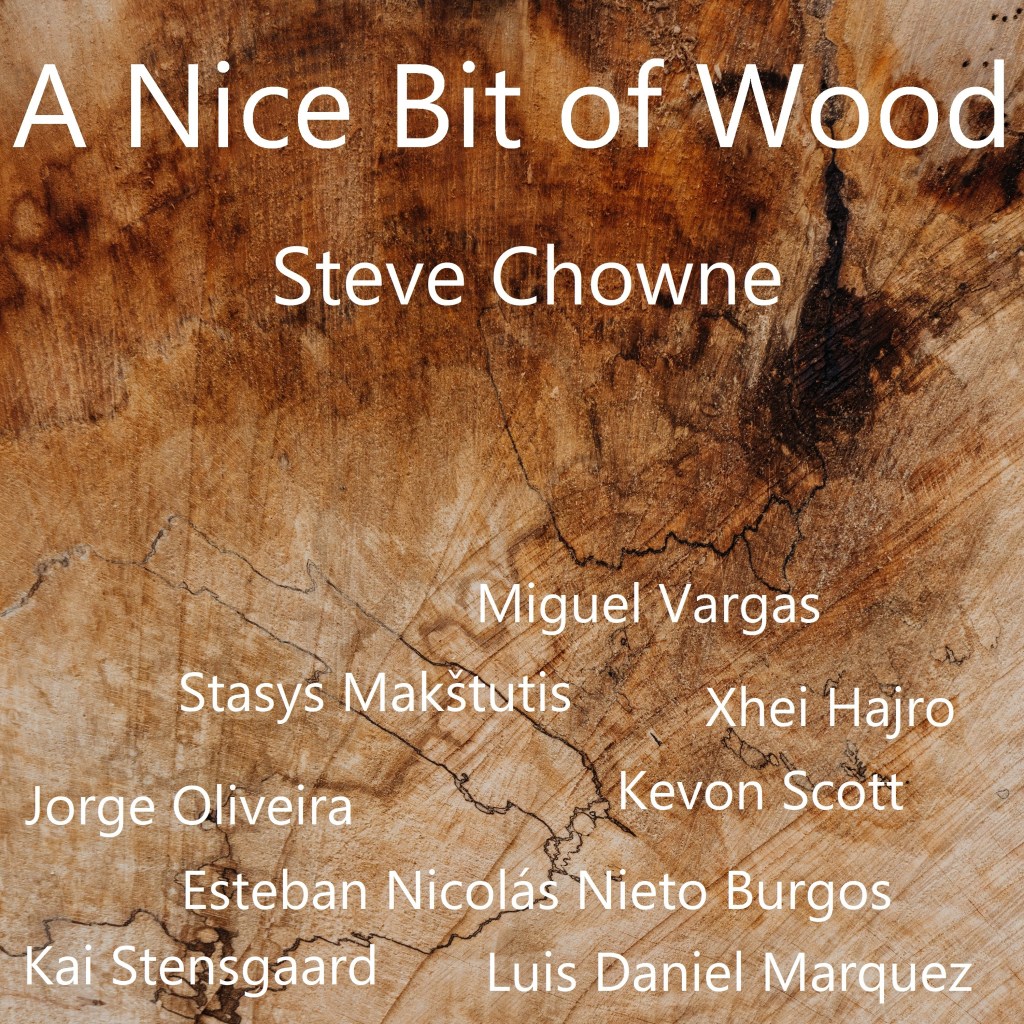
The players on these tracks were quite literally from all over the world: Jorge Olivera (Sax and synths), Kevon Scott (Sax), Miguel Vargas (Flute), Xhei Harjo (Bassoon), Luis Daniel Marquez (Oboe), Stasys Makstutis (Clarinet), Esteban Nicolas Nieto Burgos (Sax), Kai Stensgaard (Marimba) and Steve Chowne (piano and strings).
The wind orchestra behind The Limber Marimba was played and recorded by Miguel Vargas for Symph Studio.
Mixing by Luca Zara.
 Steve Chowne Music